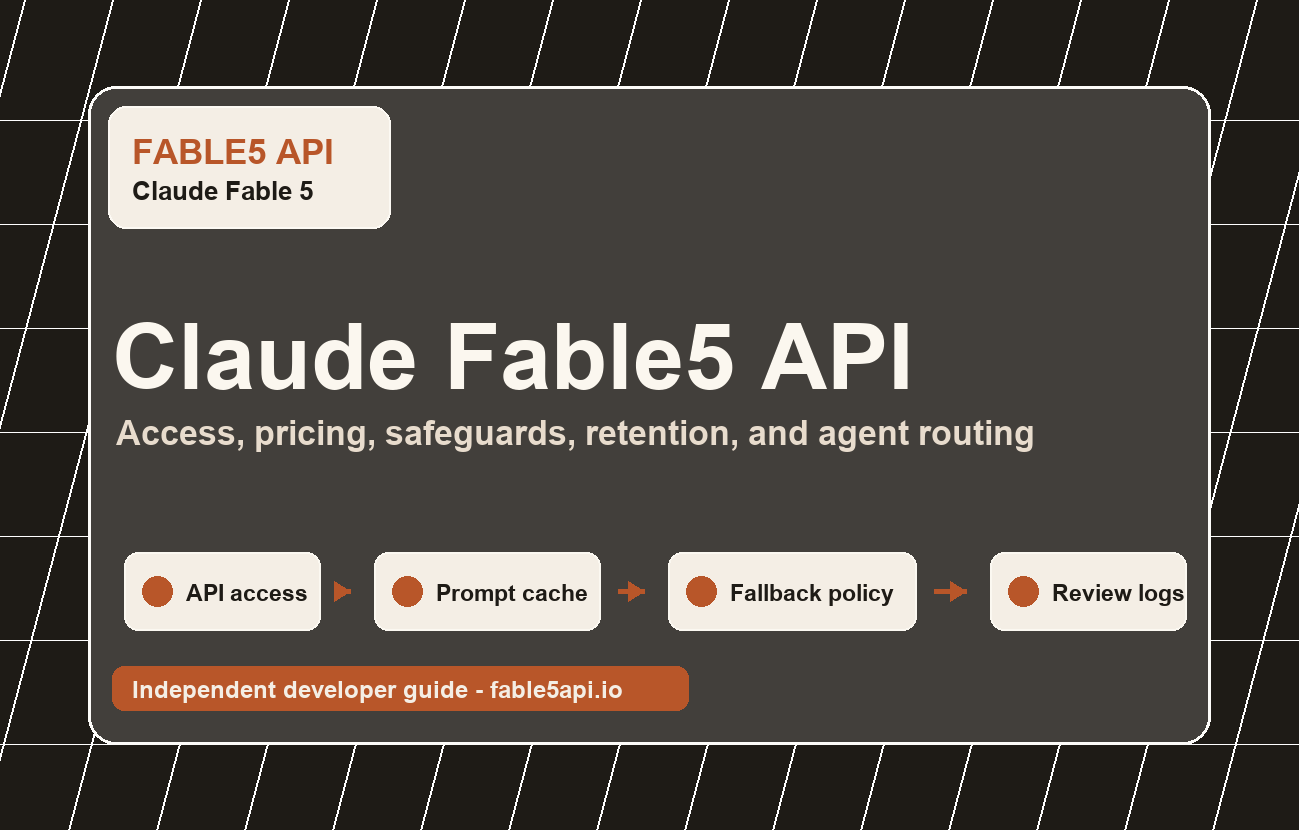
Independent API research guide - updated June 10, 2026
Claude Fable5 API guide for ambitious agent work
Fable5 API explains how teams should evaluate Claude Fable5, Claude Fable 5 API access, pricing signals, retention tradeoffs, safeguards, and production routing before they commit high-value coding or knowledge workflows to the model.
Claude Fable 5 arrived as a model for work that does not fit inside one prompt.
Anthropic describes Claude Fable 5 as a next-generation model for the hardest knowledge work and coding problems. This Fable5 API guide turns that announcement into a practical planning page for developers who need to decide whether claude fable5 is worth adding to an agent stack, an enterprise research workflow, or a codebase modernization system.
The important question is not only whether the model is powerful. The real question is whether your team has the harness, monitoring, test coverage, and review policy to make Claude Fable 5 API output dependable. This page keeps those integration details visible instead of burying them behind a launch headline.
Availability and pricing
Treat Claude Fable 5 API adoption like infrastructure, not a prompt swap.
Official availability notes list Claude Fable5 on the consumption-based Enterprise plan, the Claude Platform, marketplaces, and major cloud paths. Pricing is listed at $10 per million input tokens and $50 per million output tokens, with a prompt-caching discount for eligible input. Verify your contract and docs before you ship.
Confirm access
Claude Fable5 is listed for the consumption-based Enterprise plan and Claude Platform access. If you are building with the claude fable 5 API, first confirm that your account, marketplace, or cloud provider exposes the model before changing production routing.
Choose inference region
For US workloads, official availability notes mention US-only inference at a pricing multiplier. Put the region choice in configuration so the same Claude Fable 5 API client can move between standard and restricted deployments without code drift.
Budget prompt caching
The official pricing note lists a prompt-caching input discount. A practical Claude Fable5 API plan should separate stable system context, reusable files, and volatile user requests so teams can estimate total cost before opening a long-running queue.
Design fallback rules
Some sensitive domains can be routed away from Fable behavior by safeguards. If your claude fable 5 API workflow touches cybersecurity, biology, or chemistry, define fallback handling, audit logs, and user-facing copy before launch.
Use cases
Four places where claude fable5 deserves serious evaluation.
The claude fable 5 API is not a cheaper autocomplete lane. It is a candidate for work where extra reasoning, persistence, and self-checking can change what the system can responsibly attempt.
Long-running agents
Claude Fable5 is positioned for asynchronous agent work where a model has to plan, inspect, delegate, and verify progress across many steps. Teams evaluating the claude fable 5 API should define the harness, tools, retry logic, and human review gates before they move a multi-day workflow into production.
Serious coding programs
For large migrations, architecture changes, and complicated product builds, Claude Fable5 API planning should include repository access rules, test commands, browser validation, and a way to compare model work against the original design. The model is strongest when the task is explicit and the verification loop is real.
Document-heavy decisions
The claude fable 5 API is relevant to teams that need chart, table, PDF, and diagram understanding inside finance, legal, research, and analytics workflows. Before rollout, map what data may be retained, where the output is reviewed, and which decisions still require a domain expert.
Enterprise knowledge work
Claude Fable5 can help compress research, analysis, implementation plans, and deliverables into one durable workflow. Fable5 API keeps this page focused on the integration questions: access path, model name, pricing assumptions, data retention, and fallback behavior.
X.com case wall
100 Fable 5 use cases collected from X.
We searched X.com in the signed-in Chrome session for Claude Fable 5 demos, workflows, and early reactions, then normalized the signal into practical Claude Fable5 and Claude Fable 5 API use cases for builders.
Use Claude Fable 5 API planning for physics-first simulations that derive motion rules, predict events, and turn scientific reasoning into an inspectable demo.
Anthropic notes that Claude Fable5 includes safeguards for cybersecurity and biology, and that many flagged requests can be routed to a different Claude model. A production claude fable 5 API integration should expose those routes in logs, metrics, and review tooling so operators can understand what happened.
The official page also notes 30-day data retention for Fable safety monitoring. That detail matters for legal, finance, healthcare, research, and customer-data workflows. Before adopting Claude Fable 5 API calls, decide which workloads are allowed, which files are redacted, and when a lower-retention model should be used instead.
Production checklist
Separate evaluation, staging, and production model routes.
Record token usage, cache hits, fallback events, and review state.
Keep sensitive-domain policy near the API client, not only in docs.
Write user copy for fallback and unavailable-model conditions.
Use human review before high-impact Fable5 API output ships.
Benchmarks
Read benchmark claims as a map of where to test first.
The reference page positions Claude Fable5 as state of the art across coding, knowledge work, vision, and computer use. Do not copy benchmark language into procurement. Instead, turn each claim into a local test suite with your repositories, your documents, your operating constraints, and your review standard.
CodingLong-horizon projects, migration work, tool use
Knowledge workResearch, synthesis, planning, and review artifacts
VisionCharts, diagrams, tables, screenshots, and PDFs
Computer useAgentic browser and desktop task execution
Fable5 API turns launch-page claims into integration questions: access, region, retention, fallback, cost, and evaluation.
FAQ
Questions teams ask before adding Claude Fable5 to an API stack.
What is Claude Fable5 best for?
Claude Fable5 is best suited to ambitious, long-running, asynchronous work. A normal assistant task may not justify the extra cost, but a large coding program, multi-file research workflow, or agentic enterprise operation can benefit from the extra persistence and verification behavior.
How do I start with the Claude Fable 5 API?
Start by checking whether your Claude Platform account, cloud marketplace, or enterprise plan exposes the model. Then build a small evaluation harness with representative prompts, expected outputs, cost logging, and fallback behavior before moving any Claude Fable 5 API route into production.
Is Fable5 API an official Anthropic website?
No. Fable5 API is an independent developer guide for teams researching claude fable5 and claude fable 5 API integration decisions. Always use Anthropic and Claude Platform documentation as the final source of truth for model availability, pricing, terms, and safety controls.
What should teams watch before production use?
The biggest planning items are data retention, sensitive-domain safeguards, region requirements, prompt-caching strategy, and human review. Claude Fable5 can do more autonomous work, which makes observability and review policy more important, not less important.
Build your Claude Fable 5 API evaluation around evidence, not launch excitement.
Start small, measure the hard cases, and only move Claude Fable5 into production when the harness can explain cost, quality, fallback, and review outcomes.